Saturday, 23 June 2012

European Championships?

Every time a World Cup or European Championships comes around, most discerning football fans (that is, the obsessed types that can recite Tottenham Hotspur’s squad number list or the England starting line-up from the 1990 World Cup semi-final) hope for a bit of glory for their team, or at least some memorable moments. Viewed from Lebanon, Euro 2012 is providing the excitement in waves, like the unstoppable German through ball, run behind attack. I am but a Greek defence to resist it.

Seeing the Danes defeat the Dutch with friends from Aarhus in an empty theatre in Hamra and the lengthy taxi detour that made us late for kick-off; learning how to say ‘corrupt referee’ in Italian. England’s comeback against Sweden and Steven Gerrard's Indian summer. Rain drenching and delaying the Ukraine vs. France game while the sun beats down outside. So far, it's been one to remember. The Lebanese, meanwhile, have made the tournament their business in a way unlike any I have seen before.

Shortly before the tournament began, German flags began to proliferate around Beirut, hanging from balconies, flying from shop fronts, stuck to car doors. Some truly enormous examples can be seen draped over electrical cables between buildings. This is not a phenomenon limited to one district; all over town the Lebanese are leaving no doubt as to whom ‘their’ team is. Neither can it be called surprising from a footballing point of view; it’s natural enough for the locals to pick the best, most famous team to support in the absence of their own. Barcelona are by far the most popular club team, the Spanish World and European champions the second-best-supported national team.
 
The intensity of the support for Germany, though, is misguided. Wearing a Germany replica top or flying a flag without being able to name a single one of their players is one thing. Doing it because you think it’s synonymous with being anti-Israel is another which shows a near-comical lack of understanding of European history and an entirely messed up perception of what Germany stands for as a nation. While it’s wrong to say this is the only or even the main reason for the fervent support for the German football team on the streets of Beirut, it undoubtedly plays its part. The Lebanese have had more pressing things to worry about in the past than properly educating themselves about the Second World War, but as a European you can’t help but find the whole thing slightly bizarre.


Friday, 22 June 2012

Walking Like a Lebanese


At some point during the last month or so I reached a saturation point. Fraying at the edges, like an old elastic band that loses its structural integrity when you stretch it too far. I felt plateaued out; like I’d done all I could here for now and that it was time to leave.

I couldn’t leave, by now I was committed. One evening a couple of weeks ago I stood by the side of the road on Armenia Street, trying to take a service taxi to Hamra. It’s a relatively long trip, and drivers are unlikely to pick you up unless their car is already full of other passengers heading in the same direction. I flagged down five, six, seven different taxis. Each time I was rejected, either with a firm ‘la’ – ‘no’– or the upwards jerk of the head and tutting noise that is an alternative way of replying in the negative, much like a shake of the head. 

I had neither the energy nor inclination to get frustrated, and had plenty of time anyway. The sky was moving from blue to mauve. I stood by the passing red-number-plated Mercedes’, Skodas and everything in between, and bided my time. Eventually one of them picked me up. Minutes later I was wandering through Hamra’s Sohoesque evening pedestrian traffic, past the bars, cafés and still-open high street stores; as bustling as the cars and cabs honking and crawling along the road beside.

One of the first things I realised when I came to Beirut was that crossing the road requires a different mentality to the one you need at home. I’m a slow learner, and it took me longer to figure out that the same thing applies to walking on the pavement. The sidewalks are narrow, often obstructed by building sites that cut all the way across into the road. Cars park bumper to bumper right up to the very edge of side street junctions. Parking valets and conversing men stand in large groups which block the way entirely, and barely notice or care when someone else approaches, wanting to get past. Old women meander along in the heat, so slowly that queues form behind them. One restaurant in Gemmayzeh, not content with the challenge already present for pedestrians, has placed an inexplicably large pot plant right outside its entrance, so big that you have to walk right around the cars parked in the road just to get by.

All this used to bother me significantly. I’d arrive at language school or the TimeOut office knocked off my stride, irritated by the countless mini-detours I’d had to take en route. I mentioned this to a friend who told me that it was one of his favourite parts of the culture here. Don’t worry, just touch the bystanders on the shoulder, they’ll move without a second glance. No-one is constantly worrying or apologising for possibly being in the way, people aren’t stressed about it, they’ll get by somehow, we’ll deal with the problem as it comes. Friendly physical contact with a stranger? At home it would set alarm bells ringing. Here, no problem.

Whether this is a genuinely Lebanese way of thinking or just an adaptation to my environment I’m not sure. But it’s contributed to a feeling of belonging here, rather than the temporary status which I seemed to have exhausted.

I’ve changed my ticket again. I’ll be here until the 17th of July.

Tuesday, 19 June 2012

Cats, Cars, Graffiti


Fustu  
VW Beetle, Mar Mikhael, near the old railway


Rue Armenia
Mercedes 230, classic Beirut taxi

Time Out office orphan. He died a few days later. RIP little guy.
Hamra 
Tito 
Abandoned Range Rover, Achrafieh
Tag supporting introduction of anti-domestic violence law, Mar Mikhael. The law was not passed; husbands can still legally rape their wives.
Bar alley, Hamra
Street kitten, Mar Mikhael
Renault 12, near Sin el-Fil

Sunday, 17 June 2012

Souq al-Ahad

Head whirring, get out of bed. Take a shower. Slight improvement. Can still taste Almaza somehow. Find whatever clothes I have left that aren't emitting the very essence of 20 Lucky Strike, amble downstairs and into the morning. Cross the disused railway tracks and walk alongside them for 10 minutes, through a leafy, quiet Mar Mikhael back street. The scrapped victims of Lebanon's bad traffic and worse drivers litter a side road which heads down a hill before passing under the Pierre Gemayel Corniche flyover. Now minutes away from a hangover's worst enemy, I pass the antique and book stalls and go straight for a salty falafel sandwich, oozing with dressing and pickles. I've made it back to Souq al-Ahad.

The market in Sin el-Fil is a solid staple of many a Beirut weekend, where you can while away the hours amusing yourself browsing anything from Saddam Hussein keyrings to hammer-and-sickle coathangers to Cristiano Ronaldo bathtowels. But the traders are not to be laughed at and do serious business. Stalls sell kitchen appliances, electrical goods, fake football jerseys, watches, belts, books, spices. You can get whatever you need. There are hundreds of stalls, covered by plastic tarpaulins which are put up and taken down again every weekend. When I first discovered the souq back in March these tarpaulins kept out the rain; now they keep in the heat to steaming hot effect. Behind the main market a large area is taken up by cages. Inside the cages are kittens, puppies, rabbits, chicks, parrots, tortoises and even monkeys. I also once saw an eagle.

My personal favourite stall at Souq al-Ahad is a small used clothes stand where I've refreshed my flagging wardrobe with diverse 1990s t-shirts and printed flannel shirts. Every visit to this stall feels a bit like opening a long-sealed attic storage box, as you sift between the various items, some smart, some worthless, some plain funny.

Many of the locals that run and shop at the souq are Syrian and are from the lower end of Lebanon's socioeconomic ladder. Not many speak English, apart from 'one thousand' or 'two thousand' as they call out prices on seeing foreigners approach. Many have cassette players which blare out the names and prices of their goods on a loop, enabling them to sit back and smoke a narguileh without having to waste energy doing the announcing for themselves.

Wealthy Beirutis have a terrible attitude to the weekend market. When chatting to Lebanese in bars and mentioning a love for the souq, they commonly react with shock, asking whether it's safe to go there and why would we even want to go to such a 'dirty' place full of 'poor people'. This is mainly based on misconception as most of them have never been there to see it for themselves. I think it is somewhat symptomatic of a lack of tolerance towards other social groups by the privileged end of Lebanese society. The souq is a more welcoming place to shop than Downtown's pretentious boutiques and I have never experienced anything other than polite friendliness from the people there. Synonymous with days off, good friends and the smell, look and feel of the Middle East, it will stay with me long after I have gone from Beirut.

Friday, 1 June 2012

Beiruti

Four down, one to go. These months in Beirut have left a lasting impression.

Beirut is Trondheim. Mar Mikhael's combination of car workshops and culture. Burning gas through a 1980s heater as the cold tears through uninsulated windows.

Beirut is rainy Saturdays at Souq al-Ahad, buying new old clothes with favourite familiar faces. Taxi etiquette, Aamiyah grammar and the power of PC.

An amber-coloured Easter holiday, hangover getaway to an Aarhus-flavoured Cairo. Morning vodka with Vega on a dazzling terrace, defending the honour of a 1 foot tall white furry best friend.

A retina-threateningly bright windowless office. Pebbly beaches, Sunday traffic. The Lebanon that is not for visitors. Aching joints, mosquito bites and the view from a 6th-floor Geitawi window.

Arcing over all of it: The Corniche, Saifi, Saida, servees. Hummus, tabouleh and falafel. An apartment in Mathaf. Almaza. Tam Tam, Richard and the unforgettable Fustu. The Lebanese and their own Lebanon.

Thursday, 31 May 2012

Visiting Hezbollah HQ


Deep in the mountains of formerly occupied southern Lebanon lies Mleeta, once a stronghold for Hezbollah guerrillas, today a tour de force in museum architecture and propaganda.

Sunshine bathed the rocky southern Lebanese hills as an aging blue-green Mercedes taxi took us through several small Shia towns on the way into the countryside. Many of these small towns display posters and banners along the roadside or in their town squares, showing pictures of Hezbollah leader Hassan Nasrallah and other political figures and martyrs past and present from both Hezbollah and its political ally Amal. The unmistakeable yellow and green flag of Hezbollah flies everywhere here. Once the car had passed through the town of Mleeta itself, and continued up the mountainside for a few more kilometres, the $25 million spectacular that is the ‘Mleeta Resistance Tourist Landmark’ appeared, sitting on the crest of a hill overlooking the valley.

Hezbollah is officially classified as a terrorist organisation in many Western countries, including, significantly and not surprisingly, the United States and Britain. The truth is far less black and white, although entirely subjective. But to cut a long story extremely short, they are a Shia Muslim political party and militant group formed in 1982 in response to the Israeli occupation of southern Lebanon, which at the time extended all the way to and included Beirut, to tragic consequences. They carried out military operations and guerrilla warfare against the Israeli occupying forces until these withdrew in 2000. They now have a huge influence in Lebanese politics, holding positions in the government and with a very strong military presence in the south. Controversial for their extremely staunch anti-Israel stance, military tactics and alleged financial backing from Iran and Syria, they nevertheless enjoy no shortage of support among many communities within Lebanon due to their ability to defend the country from what many see as unjust and overly aggressive Israeli attacks, something the Lebanese Army is not always able to do. This is an attempt at a neutral presentation of a very complicated situation and any mistakes or omissions are entirely my own.

The museum at Mleeta is quite unlike any other. Built on territory from which Hezbollah fighters based their resistance efforts against occupying Israeli forces in southern Lebanon until 2000, the hillside has since been bankrolled into a first-class museum. A team of top architects worked on the museum’s design. The result is in turns impressive, surreal, bizarre and grotesque. A centrepiece named ‘The Abyss’, a huge collection of captured and destroyed Israeli tanks, artillery, jeeps and even soldiers’ helmets, is set up in a meticulously designed arrangement encircled by a walkway symbolising, in the words of the guide, the ‘tornado’ that the occupying forces found themselves caught in. The piece de resistance is a Merkava 4 tank -the pride of the Israeli army - half buried in the ground with its turret tied in a knot. ‘We have no problems with any other groups or religions, and have Christian visitors, Sunni visitors, everyone’ continued the guide. ‘The only time we have a problem is if somebody wants to occupy our land’. 

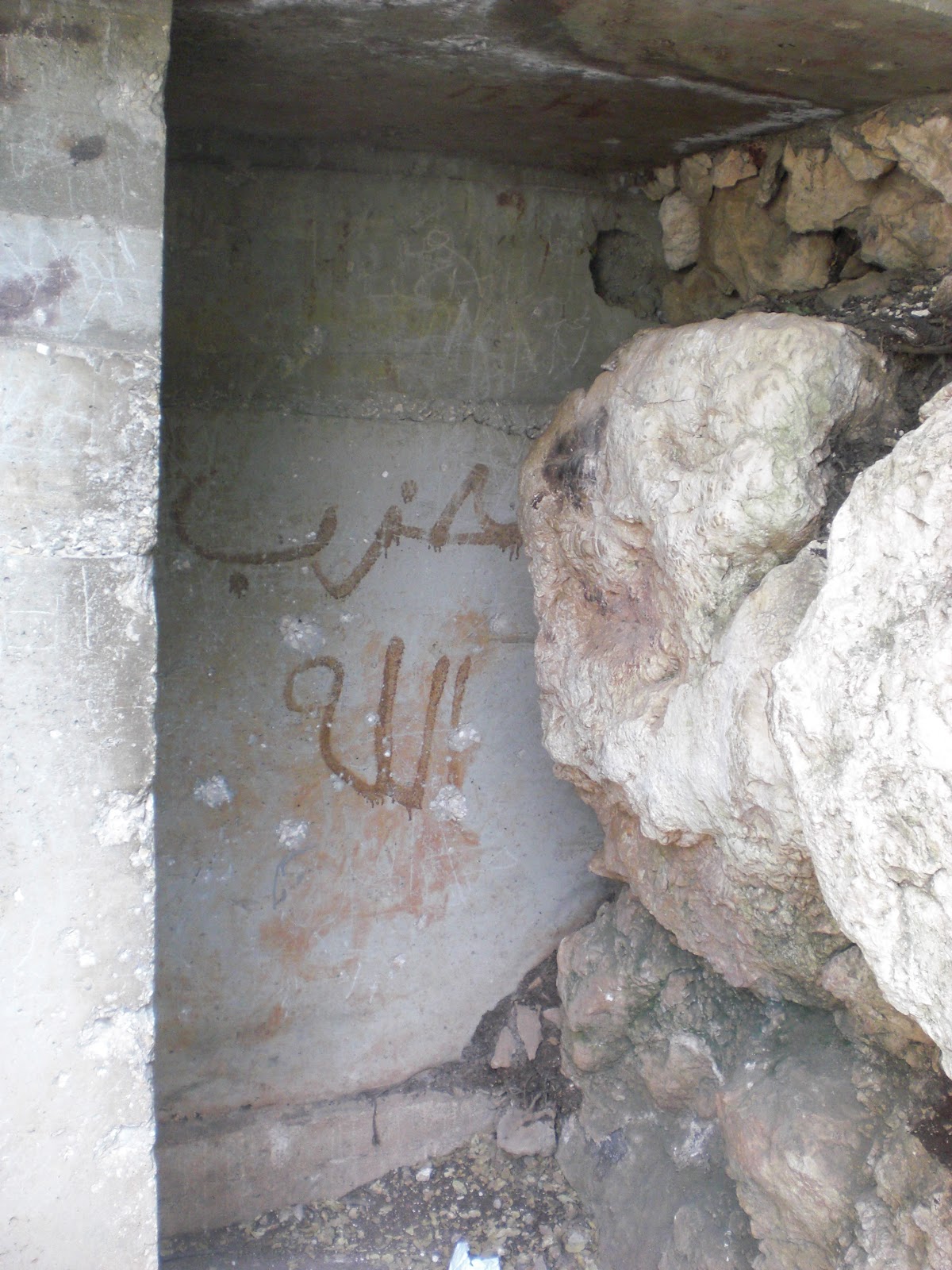
As well as The Abyss, we watched a 10-minute film in an large theatre which documented the history of the Hezbollah-Israel conflict. Including images of attacks by both sides, accompanied by Nasrallah’s powerful speeches and a dramatic score, this was a full-on propaganda broadside. We then took a walk amongst the trees and plants of the hillside, where there were several exhibits on guerrilla warfare; models of soldiers which contributed to an eerie atmosphere as they appeared through the trees; and a 200-metre long underground tunnel including a number of bunkers. The tunnel opened out onto a spectacular view over the countryside and surrounding villages. At the end you arrive at a small bunker where 'Hizbu Allah' (Party of God) is sprayed onto the outside wall. An anti-aircraft gun still stands on the inside.

On the way towards the exit, the Hezbollah experience can be completed by picking up a souvenir or two from the gift shop – a flag, a history book, or a child’s baseball cap printed with a picture of a smiling Nasrallah together with Iranian president Mahmoud Ahmadinejad. Classes of schoolchildren ran around us, enjoying their day out. They were Muslim children - I doubt schools in Christian areas would bring their classes here - but was their trip education or instruction? I think the line at Mleeta is a fine one.

Far-Off Noises

Two weeks ago I was woken during the night by a call from a friend. 'What are you doing?' he asked.
'Sleeping'.
'Okay. Stay at home tonight, we can hear gunshots and rockets from our balcony'.

I'll admit that this is perhaps an overly melodramatic way to begin a post which will now attempt to make reassurances about the current situation in Beirut. The gunshots in question were a reaction to an escalation of some unrest in Tripoli, the northern Sunni-dominated city that welcomed us so warmly when we visited at the beginning of March. During the last month or so, there have been a number of clashes between two different Sunni factions in the area. This is actually not an unusual occurrence, but many commentators are suggesting that it is a sign of the catastrophic Syrian conflict spilling over into Lebanon, as one of these groups supports the Syrian government and the other is against it.

The unrest escalated on Sunday May 20th, when two Shaykhs from the anti-Syrian group ostensibly drove through a military checkpoint (of which there are many placed on main roads throughout the country). They were both shot dead by the checkpoint guards, provoking outrage in Tripoli and accusations of Lebanese government support for the Syrian regime. The anger spread to the district of Tariq al-Jdideh in southern Beirut, where three people are thought to have been killed as tyres were burned and shots fired. The sound carried to my friend's apartment but not to mine, far away in the quiet Armenian section of East Beirut.

The following day a 'No War in Lebanon' demonstration was held on Martyrs Square at the heart of the city. No more than around two hundred people showed up, half of them foreigners. Apathy and pessimism, or just calm from a people who have seen far, far worse?

In the nearly two weeks since the first and only unrest in Beirut since the Arab Spring, no other tangible signs of trouble have been reported. The 'no news, good news' signs so far are positive, suggesting that further escalation is unlikely. Having had the pleasure of getting to know Lebanon and learning something about its people (and I do mean the whole country), anything else would be a tragedy.

After the phone call, I briefly listened through the window, then rolled over and went back to sleep. There was no reason to do anything else. Armenia Street is as safe as any place in Aarhus, Brighton or Sudbury, and will remain so for the rest of my time here and beyond.